What my grandmother’s blanket taught me about comfort
Now that you’re noticing how your home affects you—how it holds you or drains you, how it whispers calm or keeps you slightly on edge—you might be wondering what comes next.
The awareness is there.
You see it now.
But here’s where you might be getting stuck: you know something doesn’t feel right, but you’re not quite sure what would feel right. Or even, you think you know what should comfort you—what’s supposed to work, what looks beautiful in someone else’s home—but when you try it, something still feels off.
I’ve lived this tension myself.
For years, as I was moving between different apartments, different homes, I was always trying to create something that felt like home. I arranged furniture, chose decorations, and tried to make spaces visually appealing. But I didn’t actually fully understand what home actually meant to me. I couldn’t name what harmony was or how it should feel. I was just doing what seemed right, following some invisible script about how a home should look and function, without deeper awareness of what I truly needed.
However, for my most recent home, I took the time first—real, intentional time—to discover what harmony actually meant to me. Not what it looked like in design magazines or other people’s beautifully curated spaces, but what it felt like in my body, in my heart.
I had a vision, yes. But I didn’t know every detail of how it would unfold.
So I gave myself permission to work slowly. To be patient. To let the space reveal itself as I went, following intuition rather than rushing toward some finished version. It was an unfolding process—discovering what aligned as I created, allowing details to emerge naturally rather than forcing them into place.
And when it finally came together, I felt something I’d never quite experienced before:
This is me.
This is home.
Not perfectly styled. Not flawlessly arranged. Just deeply, unmistakably mine.
A sacred space where I could breathe, unfold, love, and create—my version of harmony, imperfect and true.
What I learned through this process is that comfort isn’t something you figure out intellectually and then execute. It’s something you discover by paying attention—to your body, your responses, your history, your needs.
It’s something you allow to unfold rather than force into being.
And it’s deeply, beautifully personal.
What soothes you might feel wrong to someone else. What someone else finds calming might leave you restless. Your comfort is shaped by your nervous system, your experiences, your particular way of moving through the world.
This second part of this series is about giving yourself permission.
Permission to define comfort on your own terms.
Permission to trust what actually supports you, even if it looks different than what you’ve been told it should be.
Permission to let go of the “shoulds” and choose what genuinely allows you to settle.
Because once you understand what comfort truly means to you, your home can become what it’s meant to be: a place that recognizes you, holds you gently, and gives you space to simply be.
Let’s explore what that looks like.
Why comfort is personal, not universal
What comforts one person can feel completely wrong to another, and both experiences are entirely valid.
Some people need silence to settle. Others feel unsettled without background sound—music playing softly, a podcast murmuring in another room, the hum of life happening around them.
Some find peace in visual minimalism—clear surfaces, few objects, plenty of breathing room. Others feel comforted by abundance—books stacked and visible, collections on display, evidence of living filling the space.
Temperature preferences vary wildly. Lighting that feels warm and cozy to one person feels too dim to another. Textures that soothe some bodies feel wrong against different skin.
There is no universal standard for comfort, though many act as if there is.
You might be seeing beautifully curated homes online and assume that’s what comfort should look like. You read about minimalism, hygge, or a particular design philosophy and may think, “Maybe if I do it this way, I’ll finally feel at home.”
But comfort doesn’t work like that.
Comfort is shaped by your nervous system, your personality, your sensory preferences, and your history. It might be influenced by what made you feel safe as a child, what helped you through difficult times, and what your body naturally gravitates toward when given permission to choose.
When comfort is treated as universal—when there’s supposedly one right way to arrange a home, one correct aesthetic, one proper level of order—you can disconnect from your own needs. You start forcing yourself to enjoy setups that don’t actually support you, wondering why you still feel restless in a space that “should” work.
The pressure of external standards—Pinterest perfection, design trends, what looks good versus what feels good—could make you doubt your own responses.
You might think: Everyone loves open, airy spaces, so why do I feel lost in them?
Or: Minimalism is supposed to be calming, so why does it make me anxious?
Or: This color palette is beautiful, so why does it leave me cold?
Here’s what I’d like you to know: your version of comfort doesn’t need to make sense to anyone else.
It only needs to support you.
Maybe you need your books visible because seeing their spines brings you peace.
Maybe you need a heavier blanket than most people prefer because the weight soothes your nervous system.
Maybe you need warmer lighting, cooler air, a specific chair that’s yours and only yours.
Maybe your comfort looks like a room filled with meaningful objects—photographs, plants, collected treasures—even though minimalism is trending.
Maybe your comfort looks like nearly empty surfaces because visual quiet helps your mind settle, even though everyone else seems to love styled vignettes.
Both are right. Both are valid. Both deserve space.
The moment you stop comparing your needs to someone else’s version of comfort, you gain something invaluable: the ability to actually create a home that holds you the way you need to be held.
Your comfort is allowed to be different. It’s allowed to evolve. It’s allowed to contradict what’s popular or expected.
What matters is this: does it help you breathe more easily? Does it allow you to soften? Does it give you permission to be yourself without adjustment or performance?
If the answer is yes, then it’s right—regardless of what anyone else would choose.
Separating true comfort from habit
Not everything familiar is genuinely comforting.
Sometimes what we think of as comfort is actually just habit—routines we’ve fallen into, arrangements we’ve grown accustomed to, things we keep simply because they’ve always been there.
There’s a difference between “I’m used to this” and “This actually helps me.”
And that difference matters more than you often realize.
You might have a chair you always sit in, but when you pay attention, you notice you never truly relax there. Your body shifts, searching for a comfortable position that never quite arrives. But it’s your chair, so you keep choosing it.
Or a morning routine that feels obligatory rather than restorative. You do it because you’ve always done it, not because it genuinely supports you.
Or a room arrangement that’s been the same for years—not because it works beautifully, but because moving things feels like too much effort, so you’ve stopped questioning whether there might be a better way.
Habit can masquerade as comfort because familiarity itself soothes your nervous system. The known feels safer than the unknown, even when the known isn’t actually serving you well.
But here’s the gentle truth: you’re allowed to question what you’ve grown accustomed to.
Not with judgment. Not with pressure to change everything immediately. Just with curiosity.
Does this still feel good, or am I just used to it?
Am I keeping this because I love it, or because it’s always been here?
Does this routine actually restore me, or does it just fill time?
I learned this myself when I moved to my current home and brought certain pieces of furniture and decorations from my previous life. Before I even arrived, I knew—quietly, intuitively—that some of those pieces didn’t belong in this new chapter. They were beautiful. They were familiar. But they represented a version of myself I was moving beyond.
Still, I brought a few things I thought might fit, uncertain where (or if) they’d find a place.
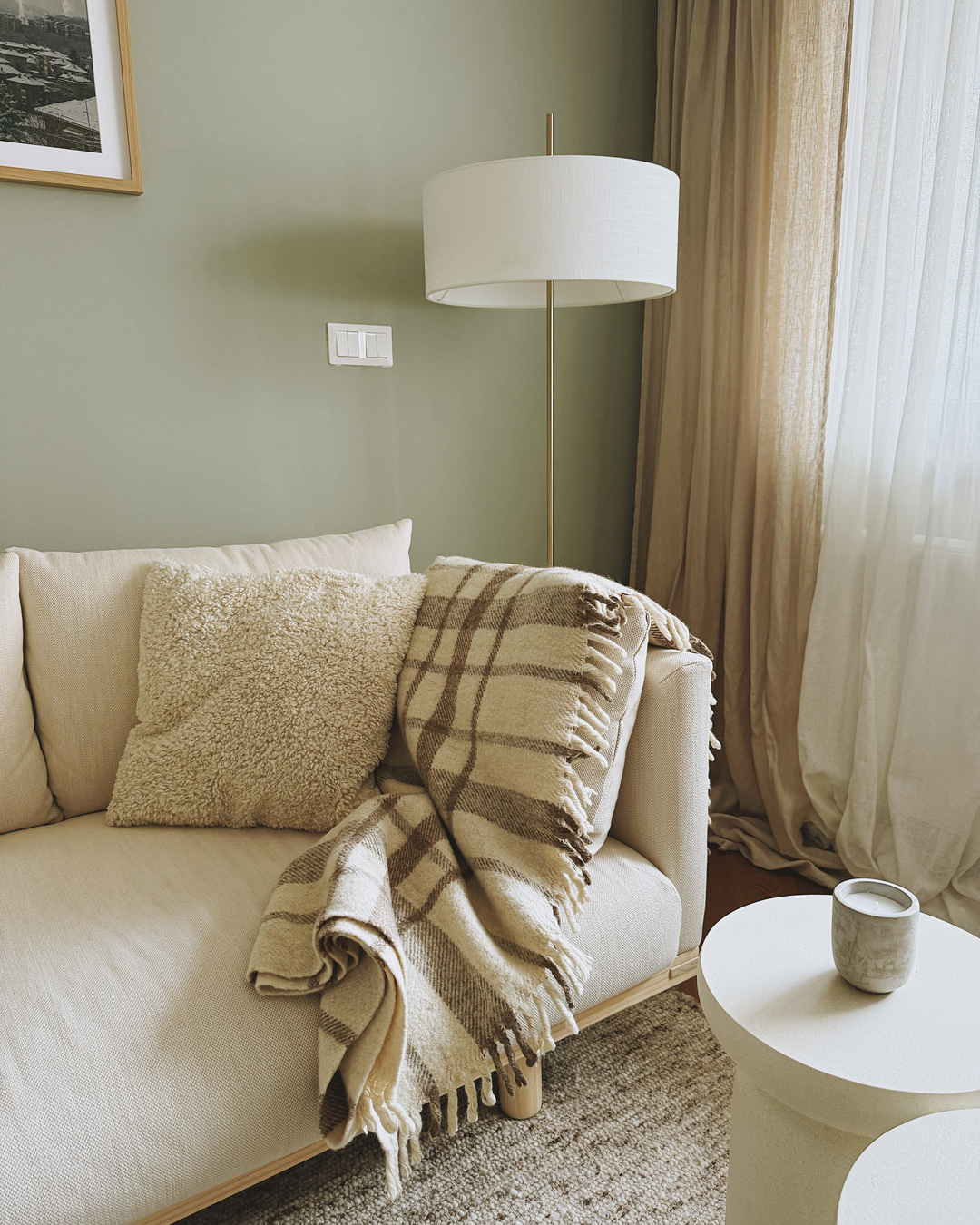
One of those pieces was a blanket my grandmother gave me—a traditional Bulgarian blanket, old and deeply loved. I knew, even before I came home, that this would belong here. Not just because it fit visually with the harmony I was creating, but because it carried something deeper: connection, warmth, roots, love.
That blanket didn’t stay because of habit. It stayed because it genuinely comforted me—emotionally, physically, spiritually.
Other things? I realized they were just familiar. And familiar isn’t always the same as nourishing.
You don’t need to remove everything that’s simply habitual. Some routines and familiar objects provide gentle structure, and that has value too.
But when you start noticing the difference—when you can feel in your body whether something truly supports you or just exists out of momentum—you gain the ability to choose more intentionally.
And that choice, made gently and without pressure, can shift everything.
Emotional versus physical comfort
A healing home considers both how your body feels and how your heart feels.
Physical comfort is easier to identify. You know when a chair supports your back or leaves you aching. You notice when a room feels too cold, when lighting strains your eyes, when a blanket’s weight soothes your nervous system. Your body gives clear feedback about what helps and what doesn’t.
Emotional comfort is quieter, subtler—but just as important.
It’s the feeling that you can be yourself here without performing or adjusting. That you’re allowed to leave things unfinished without shame. That your space accepts you exactly as you are, in whatever mood or state you’re in.
Emotional comfort means your home doesn’t ask you to be different than you are.
You can have one without the other, and when that happens, something always feels slightly off.
A space can be physically beautiful—perfectly arranged, aesthetically cohesive, every detail considered—and still feel emotionally cold. You might admire it, but you don’t relax in it. You’re careful there, aware of maintaining its perfection rather than simply living.
On the other hand, a space can be physically imperfect—a little worn, not quite styled—and feel emotionally safe. You settle there easily. You don’t worry about disturbing anything. You can sprawl on the couch, leave a mug on the table, and exist without editing yourself.
I learned this as a child without even realizing it.
My grandparents had close friends—a family we celebrated everything with, and visited often. The woman of that home was big-hearted, joyful, warm in a way that seemed to fill every corner of the space. She loved when people came to visit, and you felt that the moment you walked through the door.
Her home wasn’t shiny or stylish. It was simple, old eighties decor, nothing particularly special to look at. But it always smelled like something delicious was cooking. It felt like warmth, friendship, and deep connection. Every time I visited, I felt completely at home—even though it wasn’t my home at all.
I wanted to visit her often, not because of how the space looked, but because of how it felt.
Loved. Welcome. Belonging.
That’s emotional comfort.
It’s not created by furniture or aesthetics alone. It’s created by the energy you bring to your space—the intention, the warmth, the welcome. The way a home holds not just you, but anyone who enters.
When I was creating my current home, one of my deepest intentions was this: I wanted anyone who visited to feel the way I felt in that woman’s home. Loved. Like they belonged. Warm and welcomed exactly as they were.
Because emotional comfort isn’t just about how you feel in your space—it’s also about the energy your home holds for others.
Both matter for true wellbeing.
Physical comfort supports your body’s ability to rest and regulate. When you’re warm enough, seated comfortably, moving easily through your space, your nervous system receives permission to soften.
Emotional comfort supports your heart’s ability to settle and belong. When you feel accepted in your own home—when you can be messy or quiet or joyful or tired without judgment—you stop carrying the weight of performance.
Think about the spaces where you’ve felt most at ease. What made them different?
Often, it’s not just the furniture or lighting. It’s the feeling that you could be there—fully, messily, authentically—without needing to manage how you appeared or what impression you made.
Maybe it’s being able to leave dishes in the sink overnight without spiraling into shame.
Maybe it’s having a corner where projects can sit unfinished without making you feel like you’re failing.
Maybe it’s permission to curl up under a blanket in the middle of the day without having to explain or justify rest.
Emotional comfort is about freedom from the imaginary audience—the internalized voices that tell you how your home “should” look or how you “should” be using your space.
Your home doesn’t need to impress anyone. Not guests who might visit. Not the version of yourself you think you’re supposed to be. Not some standard of perfection you absorbed without realizing it.
It needs to hold you—body and heart—with the same gentleness.
And when you bring warmth, intention, and welcome to your space, it holds others that way, too.
When both physical and emotional comfort exist together, your home becomes a place where you can genuinely rest. Where softening happens naturally. Where you don’t have to choose between looking put-together and feeling at ease.
You get to have both. Or neither, if that’s what serves you in a particular season.
What matters is noticing: which type of comfort might your home be missing right now?
And what would it feel like to give yourself permission to tend to both?
How past experiences shape comfort
Your comfort preferences aren’t random—they’re rooted in your story.
The things that soothe you now are often connected to experiences you’ve had, places you’ve been, people who’ve loved you. You might not consciously remember every influence, but your body and heart do.
Maybe you crave warmth because you grew up somewhere cold. Maybe you need visual order because chaos once felt unsafe. Maybe you’re drawn to certain scents, textures, or sounds because they echo moments when you felt held and cared for.
These influences aren’t weaknesses or limitations. They’re part of what makes you, you.
Understanding them doesn’t trap you in the past—it helps you make sense of the present. It allows you to honor what your history taught you and to choose differently when something no longer serves you.
For example, I carry this understanding in my own home through a simple object: a blanket.
It’s an old, traditional Bulgarian blanket my grandmother gave me. When I was creating my current home and deciding what to bring from my previous life, I knew—even before I arrived—that this blanket would belong here.
Not just because it fit visually with the harmony I was creating, but because it carries something much deeper.
I was raised by my grandparents. They gave me love, warmth, stability — everything a child needs to feel safe and seen. That blanket isn’t just fabric.
It’s deep connection.
It’s roots.
It’s the feeling of being held by people who loved me unconditionally.
Now it rests on my bed, and every time I see it or touch it, I’m reminded of where I come from. Of the warmth and care that shaped me. Of belonging—not just to a place, but to Love.
That’s how past experiences shape comfort.
You might have your own version of this. A particular kind of lighting that reminds you of a home where you felt safe. A texture that echoes something comforting from childhood. A ritual—tea in the morning, candles at night—that mirrors how someone once cared for you.
Or maybe your past taught you what not to recreate. Maybe you need quiet because your childhood was too loud. Maybe you need softness because everything once felt hard. Maybe you need permission to rest because productivity was the only thing valued before.
Both are valid. Both deserve space.
Your history doesn’t dictate your choices—it informs them. You get to honor what still serves you and release what doesn’t.
The invitation here is gentle reflection:
When have I felt most at ease? What made that space different?
What textures, sounds, scents, or rituals help me feel grounded?
Is there something from my past that still comforts me now?
Is there something I’ve been recreating out of habit that I’m ready to let go of?
You don’t need to analyze everything or turn this into therapy. Just notice.
Because when you understand how your past shapes your comfort, you gain the ability to create a home that truly recognizes you—one that honors your story while giving you space to unfold into who you’re becoming.
Identifying what soothes you most
You already know what soothes you.
You might not have named it yet. You might not have given yourself permission to trust it. But somewhere in your body, in your responses, in the moments when you naturally settle—you already know.
The practice isn’t about figuring it out from scratch. It’s about slowing down enough to notice what you’ve been experiencing all along.
Where does your body naturally relax?
What sensory details help you settle?
What makes you want to stay in a space versus leave it?
These aren’t complicated questions. They just require attention.
Maybe you notice that you always gravitate toward the same corner of the couch—not because it’s the “best” seat, but because something about the light there, the way it faces the room, the softness of that particular cushion, feels right.
Maybe you realize you sleep better with weight on your body—a heavier blanket, even in warm weather—because the pressure soothes your nervous system in a way lightness doesn’t.
Maybe you need your books visible, not hidden away in closed cabinets, because seeing their spines brings you a quiet sense of order and possibility.
Maybe you need background sound—music, a fan, something gently humming—because silence feels too vast and unsettling.
Or maybe you need the opposite. Maybe silence is where you find rest, and constant noise keeps you slightly on edge.
All are valid. Neither needs justification.
Your comfort preferences don’t need to make sense to anyone else. They only need to support you.
Common elements that soothe many people include softness, quiet, warmth, order, or familiarity. But your version might look different.
You might need coolness instead of warmth.
You might need a bit more visual abundance rather than minimalism.
You might need rituals that ground you—lighting a candle at dusk, making tea in a particular mug, rearranging pillows before bed.
The difference between what you think should soothe you and what actually does can be surprisingly wide.
You might assume you need everything put away and perfectly organized to feel calm. But when you pay attention, you realize that a little bit of lived-in messiness—a book left open on the table, a blanket draped over the arm of the chair—actually makes the space feel more welcoming, not less.
Or you might think you need abundance and coziness, but discover that visual simplicity helps your mind settle in ways busyness never did.
There’s no right answer. Just your answer.
This week, try this: notice when you feel most settled. Not “happy” or “productive” necessarily—just settled. Grounded. At ease.
What’s around you in that moment?
What are you sitting on, looking at, listening to?
What temperature is the room?
What time of day is it?
What small details are present that you might usually overlook?
You’re not gathering this information to create a rigid formula. You’re simply becoming aware of what your body and heart already recognize as supportive.
Because the more you notice what actually soothes you, the easier it becomes to create a home—and a life—that offers that comfort more consistently.
You don’t need to justify your preferences.
You don’t need to explain why certain things help you settle.
You just need to trust what you notice and give yourself permission to honor it.
Letting go of external standards
Your home doesn’t need to meet anyone else’s expectations.
Not the beautifully styled homes you see online. Not the design trends that come and go. Not the unspoken rules about how a “proper” home should look or function. Not even the imagined judgment of guests who might visit someday.
And yet, so many carry the weight of these external standards without realizing it.
They feel pressure to perform—even in their own sacred space.
They apologize when someone comes over, as if their home needs to meet some invisible benchmark before they’re allowed to feel good about it.
They compare their lived-in spaces to curated images that were styled for a single photograph, then edited to perfection.
Even keep things they don’t love because they seem “right” for the kind of home they think they should have.
And slowly, without meaning to, you lose connection to what actually supports you.
External standards come from everywhere. Social media. Design shows. Other people’s homes. The way you were raised. Cultural expectations. Trends that shift every season, promising that this is finally the way to feel at home.
But have you thought about that no external standard can tell you what comfort feels like in your body, in your life, in your particular nervous system and history?
What if you prioritize genuine comfort over appearance—when you choose what supports you rather than what might look good in a photo?
That’s when something shifts.
The pressure eases. The shame softens. You stop measuring your home against an impossible standard and start experiencing it as the place it’s meant to be: yours.
This doesn’t mean ignoring beauty or order. It doesn’t mean your home can’t also be visually pleasing or well-organized.
It just means comfort comes first.
It means asking, “Does this help me breathe more easily?” instead of “Does this look right?”
It means choosing the worn, soft chair that supports your back over the stylish one that looks better but leaves you aching.
It means leaving space messy when you need rest more than you need everything put away.
It means giving yourself permission to create a home that serves you—not one that performs for an imaginary audience.
Because here’s what happens when you release comparison:
You stop feeling inadequate in your own space.
You start noticing what genuinely brings you peace.
You make decisions based on care instead of obligation.
Your home becomes a place you can actually relax in, rather than a place you’re constantly trying to fix or improve.
What if comfort mattered more than how it looks in photos?
What if your home didn’t need to impress anyone—including the version of yourself you think you’re supposed to be?
What if the only standard that mattered was whether your space allowed you to soften, settle, and feel at home in your own skin?
You’re allowed to want what you want.
You’re allowed to need what you need.
You’re allowed to create a home that reflects your actual life, not someone else’s idea of what your life should look like.
Trends will come and go. Styles will shift. Other people will always have opinions.
But your comfort—the specific conditions that help you rest, regulate, and feel held—that’s worth honoring above all of it.
Creating a personal comfort baseline
Your comfort baseline is your reference point—and it’s allowed to evolve.
It’s not a rigid rule or a fixed formula. It’s a living understanding of what helps you feel at home in your own body, your own space, your own life.
Think of it as your personal definition of “this feels like home to me.”
It includes the conditions that help you relax, function, and recover. The sensory details that soothe you. The emotional qualities that allow you to soften. The small rituals or arrangements that support your wellbeing without demanding perfection.
You don’t need to write it down formally (though you can if that helps). You just need to hold it gently in your awareness—a quiet knowing that guides your choices.
Creating this baseline is simple. It comes from everything you’ve been noticing:
What have you learned about yourself through this reflection?
What patterns have emerged in the moments when you feel most settled?
What do you now understand about your comfort that you didn’t see before?
Maybe your baseline includes warmth, soft lighting, and familiar objects within view.
Maybe it includes quiet mornings, a specific chair, and permission to leave things unfinished.
Maybe it includes background sound, cool air, and spaces that invite movement rather than stillness.
Whatever it is, it’s yours.
Once you have this understanding—even loosely, even imperfectly—it becomes easier to make decisions about your home.
When something shifts, or you’re considering a change, you can ask: Does this support my comfort baseline, or does it work against it?
Not every decision needs to align perfectly. Life is full of compromises, transitions, and seasons where your home can’t be exactly what you’d choose.
But having a baseline helps you recognize when you’re moving toward comfort and when you’re moving away from it.
It also makes it easier to say no.
No to trends that don’t serve you.
No to arrangements that look good but feel wrong.
No to pressure from external standards that don’t match your actual needs.
And easier to say yes.
Yes to the things that genuinely help you settle.
Yes to choices that honor your body and heart.
Yes to creating a home that recognizes you, even if it looks different than what others might expect.
Here’s an essential part: your baseline can change.
What soothes you in one season might shift in another. What supports you during a busy, stressful period might feel different when life slows down. Your needs during winter might differ from those in summer. Your comfort at 40 might evolve by 50.
That’s not failure. That’s growth.
Your baseline isn’t meant to lock you in place. It’s meant to help you stay connected to yourself as you move through different chapters of life.
Returning to it regularly—noticing when something no longer feels aligned, recognizing when a new need has emerged—keeps your home responsive to who you’re becoming, not just who you were.
So as you move forward, carry this quiet question with you:
What does my comfort baseline look like right now?
Not forever. Not perfectly. Just now.
And trust that you’ll know when it’s time to adjust.
The gift of permission
Permission is a gift you give yourself.
Permission to choose what soothes you, even if it looks different than what others prefer.
Permission to trust your own responses instead of second-guessing them.
Permission to let go of “shoulds” and create a home that actually supports you.
This is what comfort asks of you: not perfection, but honesty. Not a finished product, but an ongoing conversation with yourself about what you truly need.
Defining comfort isn’t something you do once and check off a list. It’s a living process—one that unfolds as you pay attention, as you notice what helps and what doesn’t, as you grow and change through different seasons of life.
You don’t need to have it all figured out right now.
You don’t need to redesign your entire home or make sweeping changes.
You just need to stay curious. To keep noticing. To trust that you already know more than you think you do about what supports you.
This week, if you’re ready, try this:
Notice one thing in your home that you’ve been tolerating—something that doesn’t quite feel right, something you’ve grown used to without questioning whether it actually comforts you.
Don’t change it immediately. Just ask yourself: Does this truly comfort me, or am I just used to it?
That’s all. One gentle question. One moment of honest noticing.
Because awareness is the beginning. Understanding comes next. And from there, small shifts become possible.
Once you understand what comfort truly means to you—what soothes your body, what settles your heart, what allows you to feel at home in your own skin—the next step is learning how to care for that comfort without pressure.
How do you maintain this gentle support even when life gets busy?
How do you tend to your home in ways that feel nourishing rather than overwhelming?
How do you keep your space aligned with your wellbeing when energy is low and time is short?
That’s what we’ll explore in the final part of this series: caring for your home as an extension of caring for yourself—with the same gentleness, the same patience, the same permission to be imperfect.
Until then, may you give yourself the gift of defining comfort on your own terms.
May you trust what soothes you, even when it contradicts what you’ve been told
And may your home become a place that recognizes you—exactly as you are—and holds you gently.
You May Also Like